 7th International Traditional Archery Tournament “Historical Park”7th International Traditional Archery Tournament “Historical Park” Following our trip to the 7th International Traditional Archery Tournament (VII International Traditional Archery Tournament), held in Varna, Bulgaria, from September 18–20, 2026, we spent the following three days of our journey exploring Historical Park and the Festival Zone in Neofit Rilski, before spending our final day in Burgas. This article was written to share our observations, impressions, technical details, newly forged friendships, and the traces of our shared history that we encountered in Varna, Neofit Rilski, and Burgas during and after the competition.
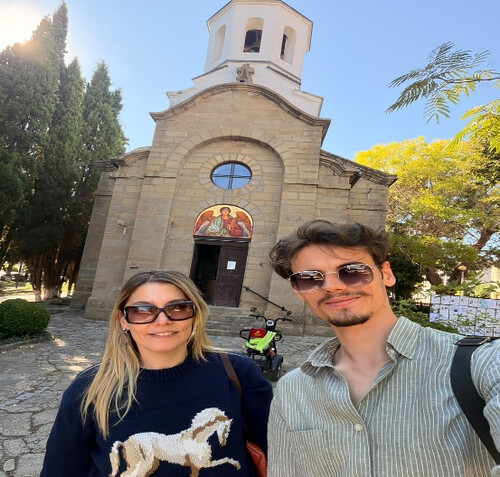
Historical Park / Neofit Rilski / Varna Hilal and I set off from Istanbul at 5:30 AM. Traveling along the quiet roads of Thrace, we arrived at the Hamzabeyli Border Gate at around 8:30 AM. After completing the border procedures and crossing into Bulgaria, our first stop was the town of Sungurlare, where we took a pleasant lunch break. Meeting Ms. Zeliha—who greeted us after hearing us speak Turkish as she passed us on the street and then welcomed us with her warm conversation—was the first lovely surprise of our journey.
Ms. Zeliha, a resident of Sungurlare After a pleasant break in Sungurlare, we arrived at Historical Park, located in the village of Neofit Rilski near Varna. Covering 500 decares (approximately 123 acres), Historical Park is one of the world’s largest cultural-historical parks of its kind, featuring authentic fortress walls and architecture representing five major historical eras—from the Chalcolithic and Neolithic periods through the Thracian and Roman eras and the First and Second Bulgarian Empires.
Traveling through history and geography to reach such an atmosphere did not feel like merely attending a sports competition. For us, Rumelia was a lost memory whose spirit, architecture, and subtle grief still live on in these lands. Standing on these same lands with our bows in hand carried a truly distinct meaning for us.
We shook off the fatigue of the journey with a brief rest. Our hotel was only ten minutes away from the venue. As we made our way to the grounds and completed our registration, we realized that we were part of a major international event. More than 200 athletes from 15 different countries—including Bulgaria, Slovakia, Poland, Moldova, Romania, Hungary, Spain, South Korea, Greece, Germany, India, Ukraine, the USA, North Macedonia, and Turkey—had gathered in Neofit Rilski.
Historical Park Registration Area One of the finest traditions of international competitions—the tradition of exchanging gifts among archers—was experienced here in all its warmth. The necklace gifted to us by Haki from Hungary, the magnificent badge given to us by Thomas from Slovakia, and the wonderful patch from Maria from Spain became unforgettable tokens of this culture.
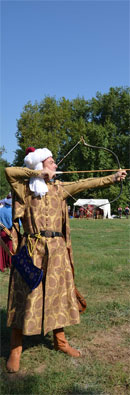
A tremendous variety of techniques and equipment was also present on the field. While some archers preferred the traditional thumb draw, others demonstrated three-finger techniques. In terms of equipment, Tatar-style bows were particularly common. In our conversations and interviews with many participants, we observed that bows ranging from 33 to 38 lb were generally preferred. Participants meticulously numbered their arrows and carefully marked technical parameters such as FOC (Front of Center balance), GPP (grains per pound), and total arrow weight directly on the shafts. Great care was taken in selecting historical costumes; however, distracting items such as loose jewelry or necklaces that could interfere with shooting form were avoided. Meanwhile, our kinsmen living in Bulgaria—Ayşe, Taner, Cüneyt, and Berkan—made us feel at home with their warm hospitality. The organization of the event was truly remarkable. Arrows lost during the shooting rounds were individually collected by the crew at the end of each day and placed in a dedicated room at the registration area—a very thoughtful gesture. Having a judge and a water dispenser at each target station ensured that we could stay hydrated under the warm sun. Shooting sessions began at around 9:30 AM and were followed by lunch at approximately 1:00 PM. The meals were prepared with great care, providing athletes with a good balance of carbohydrates and protein to support them throughout the competition. The first day of the tournament began with flight archery (distance shooting), one of the purest disciplines of traditional archery. Reading and adapting to the changing winds on the field, we brought the excitement of the first day to a close.
At the end of the day, the event organizer, Mr. Boyan Petkov, gave us an unforgettable evening. Bulgarian national folk dances, songs performed by Boyan himself, and captivating fire dances made us forget all the fatigue of the first day. The second and third days featured a massive two-day target archery marathon covering a total of 24 targets. Competitors battled across two distinct course areas: Historical Park and Festival Zone. The targets in the Historical Park area were dynamic stations that required shooting from authentic castle walls representing thousands of years of history, from a boat, from steps, from a lying position, at rotating targets, at mechanically moving targets, and at 3D animal figures. On the evening of the second day, an unforgettable closing ceremony took place with the participation of all the athletes. Targets in the Festival Zone included shields, Hungarian targets, Korean targets, a 165-meter English flag target, a 145-meter Korean target, a 90-meter Hungarian target, a 60-meter Ottoman puta, Tibetan targets, cylindrical targets, and various long-range shooting challenges. The award ceremony and closing celebration on the third day were filled with great enthusiasm. Everyone captured the moment with commemorative photographs. One of the most thrilling highlights of the tournament was the 90-meter Mongolian target event, consisting of cylindrical blocks lined up side by side on the ground and requiring an extremely high level of wind calculation. In this challenging category, in which 80 master archers representing 16 teams competed, our efforts earned us third place. On our return journey after the competition, we stopped in Burgas. We added a culturally rich finale to our trip by visiting the Burgas Regional Historical Museum, which houses exhibits showcasing the city’s historical heritage, as well as the majestic Church of Saints Cyril and Methodius. We then crossed back into Turkey through the Dereköy Border Gate.
As we headed toward Istanbul with the wind of Rumelia at our backs, we returned home carrying unforgettable friendships, cherished gifts, and the indescribable experience of shooting arrows on lands where our ancestors once left their mark.
 |